Showing posts with label Morgan. Show all posts

Tuesday, 23 June 2015

Whale Watching with Cape Ann Whale Watch

It has been a while! WhaleFest 2015 was over 3 months ago! Doesn't time fly!

For our little Morgan time has been flying the company of whales, those working to protect them and those who are loving watching them (in a responsible way of course!). Morgan was now back out in the USA with WCA Partner Patti Sullivan and Paul DiGangi, and as we moved into Spring and then Summer, what better to do then get out on a whale watch! (To be honest regardless of the season or weather, for Morgan the best thing to do is always be out on the open ocean with her family!).

So Morgan, Patti and Paul headed out with Cape Ann Whale Watch off Gloucester, Massachusetts in search of whales. 

Morgan and Paul with the wonderful crew and some huge baleen!

Onboard the Hurricane II Morgan met loads of excited passengers, and Cynde Bierman McInnis who not only runs the comprehensive educational programme that is integrated into all Cape Ann Whale Watch trips but also is the Chair of the Responsible Whale Watching Working Group of the WCA and is taking the lead on the new joint educational initiative called the Net Effect Campaign. Through this WCAs responsible whale watching partners aim to talk to passengers about the issues of bycatch and ghost gear which continues to trap, injure and kill all kinds of marine wildlife including whales and dolphins once it is lost or discarded. 

Morgan, Paul and the fab Cynde

It was quite a trip and a brilliant day, with kids and adults alike getting fantastic encounters with majestic humpback whales, the full educational experience of whale watching with Cape Ann Whale Watch as well as learning the story of one young Orca kept away from her family and her rightful place in the beautiful open ocean.

One of many encounters that day with a humpback whale!

Enjoying time with Leandra, Layla and Andrew 
Read more about the Responsible Whale Watching Working Groups's Net Effect education initiative at the WCA website.

Saturday, 21 March 2015

WhaleFest 2015 - Happy 1 Year Anniversary Follow Free Morgan!

It has been a year since our little Morgan started off on her adventures. In that time she has travelled all over, from the states of Hawaii and Connecticut in the US, to Portugal, Panama, Iceland, Baffin Island and the Azores to name a few. She has watched humpback whales, bowhead whales, narwhal, minke whales, fin whales, blue whales, Risso’s dolphins, pantropical spotted dolphins, harbour porpoise, common dolphins, Cuvier’s beaked whales and even some of her own kin, orca. She has petitioned against keeping cetaceans in captivity, learnt how to be a marine mammal observer, attended a vigil for Hector’s and Maui’s dolphin’s and even gone diving. 

Now a year on and she was back where it all started, in Brighton for WhaleFest 2015. This time at held the Brighton Centre with wonderful panoramic views of sea and beach, and the emotionally charged WCA Whale Graveyard. The installation set on Brighton beach, just in front of the Brighton Centre, comprised over 5,000 crosses each bearing the name of a whale or dolphin that has died in captivity, set in the shape of a mother and baby orca. After all the rush of setting up and getting ready with the other volunteers for WhaleFest 2015, our little Morgan took a moment with a setting sun to reflect on the meaning of this display and hope that it is not the future for her namesake Morgan held in Loro Parque, and for all the other orca currently held in captivity. For them our little Morgan hopes for a better solution of retirement and for some perhaps even release back to the wild. 

The WCA Whale Graveyard

Then it was time for the festival itself, bringing back many of the aspects Morgan enjoyed last year from Virtual Whale Watching, Science and Campaign talks from some of the most prominent researchers and campaigners in the whale and dolphin, experts and artefacts including the amazing narwhal tusk, a submarine dome experience and stalls from hundreds of charities and whale watching companies from around the world. Once again the amazing Main Stage included talks from inspirational people like Gordon Buchanan, Monty Halls, Ric O’Barry, Will Travers, Steve Backshall, Michela Strachan and John Hargrove. Surrounded on all sides by inflatable life sized whales and dolphins. Interspersed with their talks were passionate volunteers talking about a particular species of whale or dolphin. There was face painting, pottery painting, arts and crafts, a whole zone dedicated to sharks, yes its WhaleFest but all such creatures play an important role in our oceans ecosystem and all need protecting. Here you could wander up close to life sized sharks and even explore a cave. There were sea shanty’s being sung and people everywhere! The whole event was bigger and better than last year, with thousands of people coming through the doors and being inspired about whales, dolphins and our oceans. For those who could not attend the event there was the Live Lounge, streaming interviews with celebs, campaigners and researchers to a wider audience through the internet. 

Loving the Sea Shanties

Once more the whole event was run not for profit, with money raised going to the World Cetacean Alliance and its campaigns. As well as generous donations collected over the weekend there was an auction of amazing, once in a life time experiences kindly donated by WCA partners, including trips kayaking with orca in Canada and whale watching in Baja, California. On top of this were the amazing Whale Tails, one for every orca currently in captivity and painted by local artists with their wild soul. Signed by such people like Steve Backshall, John Hargrove, Will Travers and Jean Michel Cousteau each was then auctioned off with the money going to the Wild and Free campaign. 

The amazing Whale Tails

Once more our little Morgan was inspired by the passion of those around her, yes by the big names bringing and sharing their experiences and knowledge to a wide audience, but more so by the hundreds of volunteers who had given their time, energy and effort to make the whole event a reality. It is they who inspire our little Morgan the most. 


Photo Gallery by QuickGallery.com

Monday, 16 February 2015

The Telegraph Outdoor Show

It is exactly one month to go until WhaleFest 2015, the world’s largest festival for wild whales and dolphins. This year will also be the 1 year anniversary of the launch of Follow Free Morgan! 

Amongst all the planning for the main stage, the campaigns and science talks, the virtual whale watch, shark zone, experts and artefacts; the organising of exhibitors and celebrities, expert speakers and an amazing art installation that will get the world thinking on the campaign of Wild and Free. Amongst all this the WhaleFest team took part in the Telegraph Outdoor Show in London, promoting our wonderful festival and encouraging more people to get involved with the Wild and Free Campaign and taking #whalefies! 

Eye to Eye: Morgan's #whalefie with the WhaleFest Whale

The event ran over four days from Thursday 12th to Sunday 15th February and our little Morgan joined in the fun of the WhaleFest PopUp on the Thursday. 

The PopUp saw the very first public outing of WhaleFest’s very own huge inflatable Orca funded by wonderful donations through the Whale of a Time crowd funder campaign. 

There were banners and posters telling everyone about WhaleFest, the WCA and their work being done to protect wild whales and dolphins. There was also the brand new WhaleFest Virtual Whale Watch boat all ready to take people whale watching in Brighton!

The inflatable orca and new virtual whale watch boats! Whoop!

As the weekend progressed the PopUp saw Monty Halls and Steve Backshall adding their support and an almost continual procession of people taking their #whalefies! Why not checkout all the #whalefies taken for the #wildandfree campaign at the WhaleFest Facebook Page!

For our little Morgan it was an exciting day, and just a tiny taster of what WhaleFest 2015 is going to be all about! Here's hoping we see you all there!

Have you taken your #whalefie yet? Why not do so now!? Take a selfie with anything related to a whale or dolphin! The #whalefie should represent whales and dolphins that are wild and free! Send you #whalefie to whalefie@planetwhale.com and post to your social media! 


Wednesday, 4 February 2015

Under the Sea

For our little Morgan, as a soft toy her interaction with the marine environment is mainly like ours, from the surface. Observing marine life as it breaks that barrier, for whales and dolphins this is essential. As mammals they breathe air like humans which means that they must surface in order to breathe. The time they can hold their breath, while much longer than humans, varies from 10 minutes or so for many dolphins to over an hour for the mighty sperm whale. But ultimately they all must come to the surface and breathe. This is where most of our interaction with whales and dolphins occurs. Some are lucky to swim with them in the wild, experiencing the wonder of interacting with them under the waves. Most encounters however occur at the surface, and this is where Morgan has been experiencing fantastic encounters with her kin. 

In September last year however, Andre Cid from AIMM took Morgan under the water for the very first time. In the warm, blue waters off Arrabida Portugal, Morgan went diving with Andre Cid as he undertook a survey of the seabed habitat. They were joined by renowned underwater photographer Athilla Bertoncini. He took some truly magical pictures of Morgan under the water.

Morgan diving with the scientific divers

The survey was part of a wider project to determine the biodiversity that exists around Portugal. Andre and Morgan surveyed a 50 m line counting all the fish they saw, then they visually determined the vegetation cover. Each line was also videoed and any unusual species of marine creature they saw they took pictures for future identification. Other divers recorded sponges, corals, micro algae, plankton. Over the course of the recent surveys the team has recorded 40 species that had previously not been described in this area of Portugal! 

Surveying the marine life

The whole marine ecosystem is interconnected. To protect whales and dolphins, we need to protect their habitats. Before we can protect marine creatures and their habitats we need to know what is there.  What a thrill for Morgan to be at the very forefront of marine discovery!

Simply enjoying the magic of being under water

Thursday, 11 December 2014

A Whale of a Time

Imagine standing next to a life sized Orca. For some of us we have been lucky enough to be on a boat, big or small, when one of these magnificent marine mammals surfaces nearby. The moment is inspirational, breath taking and one that many do not forget. Even then you only see a small part of the animal. Perhaps the head, back and enormous dorsal fin towering above the waves. Occasionally you might be really lucky to see one leap clear, throwing themselves out of the water and crashing back down with an almighty splash. But not everyone is so lucky, whether they cannot afford to go, or are not near any prime Orca habitat. So again imagine standing next to a life sized Orca. It is big, reaching almost 10 m in length and its tall, to the tip of its dorsal fin it towers over you, your mum, even your really tall dad! It’s bold, black and white with huge paddle like flippers. It is a view very few would ever see in a wild animal, and who wants to see the shadow of a wild Orca that is those subject to a life in captivity. 

A wild and free Orca

There were so many wonderful things at WhaleFest 2014, things that really inspired kids, parents, students and anyone else who ventured to the world’s biggest festival of whales and dolphins. And it wasn’t just Steve Backshall (although he was pretty inspirational!). For our little Morgan what really stuck in her mind was things like the life sized humpback whale, based on a real, known whale off America called Niall and the release of a life sized Orca into the sea off Brighton. Of course (and unfortunately) it was not a real Orca, but it looked pretty realistic. Such items have a massive impact. So imagine being able to have a life sized Orca to use year after year at WhaleFest and to take on the road to events around the country? Imagine being able to inspire hundreds, thousands of people by bringing them into close contact with a life sized whale, inspiring them to care and to protect these incredible creatures.

Morgan at WhaleFest 2014, with the life sized inflatable Orca

WhaleFest has fantastic support from those people who currently own such incredible replicas. But to be able to really make this work the team needs their own replica. Their own inflatable life sized Orca. And to do that they need help. Overall the funds needed may seem overwhelming, a large sum of money. But break it down into small chunks and ask your friends, your friends friend, your mum, your dad, your aunty, your work colleagues, everyone and anyone to make one small donation and very soon that large sum is reachable. And that is the idea behind crowd funding. 

And so WhaleFest has launched a crowdfunding appeal backed by Monty Halls, Gok Wan and supported by The Body Shop Foundation, to raise enough money to build a life sized replica Orca. But more than that it is supported by general people who have pledged their support for this inspirational idea. Our little Morgan has pledged her support, and would ask will you too?

There are only 21 days left and still 50% of the funds to go. Will you pledge, share and support the WhaleFest Team? Will you help bring to life an idea that will inspire generations to love and protect whales?


Friday, 5 December 2014

Surveying Cetaceans in Portugal

From enjoying Humpback Whales in Hawaii and Panama, Morgan was back across the Atlantic and participating in a survey for cetaceans and turtles with WCA partner AIMM – Marine Environment Research Association in Portugal. AIMM conducts research in partnership with universities, research centres and other Non-Governmental Organisations, to increase the knowledge of marine ecosystems in Portugal. 

On board the Portuguese Navy vessel the Creoula

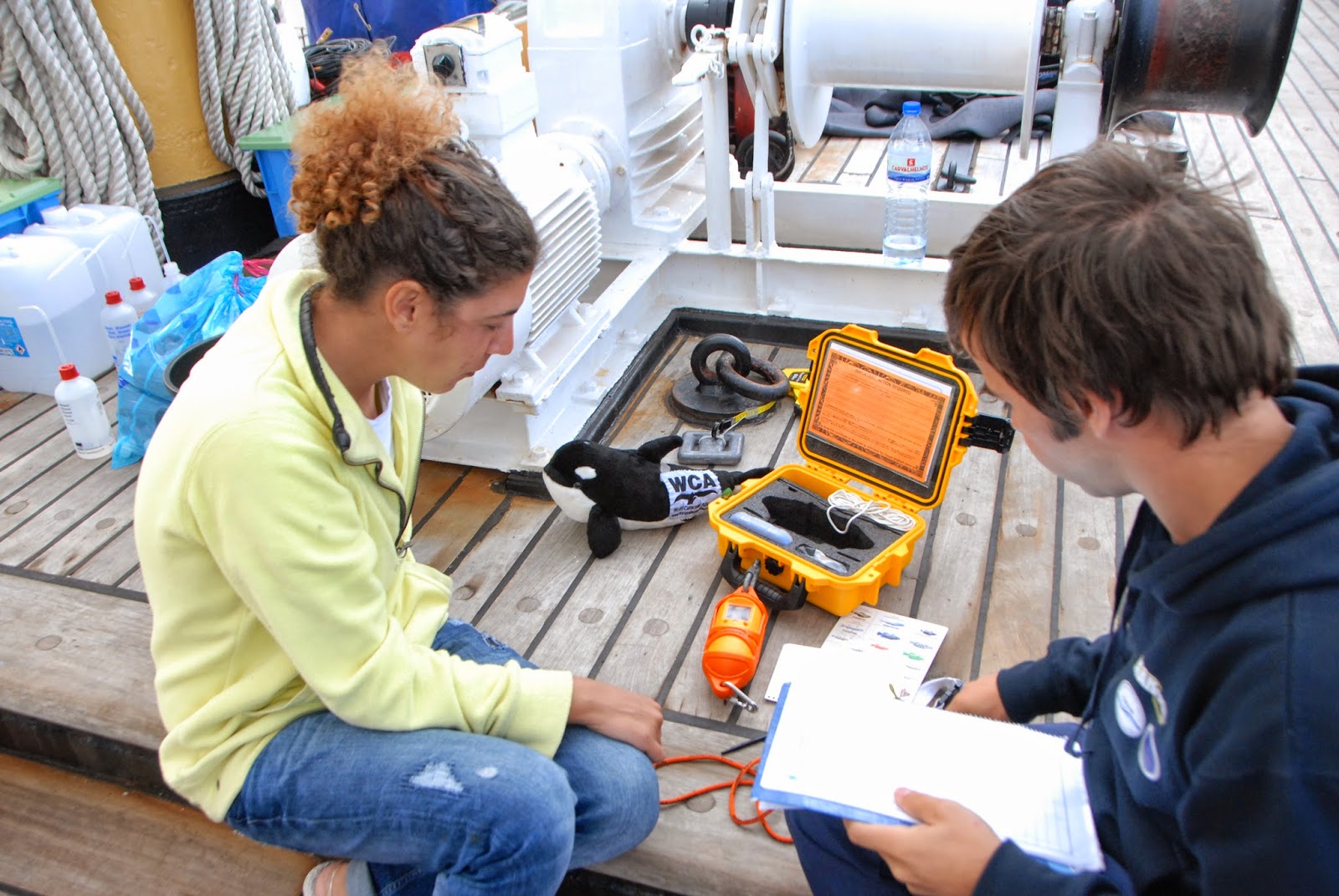
Andre Cid from the organisation and Morgan took part in scientific survey off the coast of Portugal to establish what biodiversity exists off the coast and where. While the survey looked a range of marine life, Morgan and Andre Cid were there to survey for cetaceans and turtles.   

Working with the scientists on board

On board the beautiful Creoula, originally a cod fishing boat used in the North Atlantic and now a training ship of the Portuguese Navy the team recorded all the whales, dolphins, porpoises and turtles they saw. This data will go towards identifying which species occur in the area, estimating the spatial distribution and relative abundance (i.e. where they occur and how many are there), assessing habitat use and population structures and towards comparing photo-identification pictures (photos of the dorsal fin that allow individual animals to be recognised) with existing catalogues.  

Looking out for whales and dolphins!

In addition to conducting visual surveys the team also monitored for whales and dolphins acoustically using a hydrophone, which is basically an underwater microphone that will pick up the clicks, whistles and any other vocalisations that the whales and dolphins may be making. By plugging the hydrophone into a computer these vocalisations can be recorded and also visualised on screen. 

Click to discover more about the work of AIMM!

The acoustic monitoring system

Thursday, 27 November 2014

Matylda and Morgan

There once was a little girl called Matylda who went on a wonderful adventure to Panama with her mum, dad, little sister Edith, and a very special little Orca called Morgan. Nestled in central America with the Caribbean Sea on one side and the vast Pacific Ocean on the other, Panama is home to wild tropical jungle, golden sandy beaches and blue turquoise water filled with coral reefs, colourful fishes and a multitude of marine creatures including whales and dolphins. Morgan was honoured to join this family on their adventure, and while she cannot speak ‘human’ Matylda has spoken for Morgan by writing down her adventures with this little whale in this special place.

Morgan's Holiday Book By Matylda

Matylda, her family and Morgan headed to Contadora Island, set off the southern, Pacific coast of Panama and here they headed out in search of humpback whales and dolphins. In Matylda’s words "Morgan has had a brilliant time with us. Morgan came on a boat trip with us and another family. We saw Humpback Whales. Morgan went on a catamaran and we saw Spotted Dolphins but Edith was asleep. We were on a net (the cat had a net to sit on the bow). We had a brilliant time!"

Matylda's drawing of her family and Morgan onboard a catamaran whale watching!

Did you know that Panama is the only place in the whole world where Humpback Whales from both the Northern and Southern Hemisphere come to breed!? The dolphins that Morgan and Matylda saw were Pantropical Spotted Dolphins, the species most commonly encountered in the waters off Panama. They are curious and very interactive, often swimming for hours and playing around the boats.

Pantropical Spotted Dolphin (not from Panama but the same species!)

Morgan and Matylda went whale watching with World Cetacean Alliance Partner, Whale Watching Panama. Click here to find out more about their trips and the magical place of Panama! 

Finally it is just left to us to say 'Thank You' to Matylda for taking our Morgan on this adventure, for speaking for her and telling us all about your adventure together.

Wednesday, 10 September 2014

Arctic Explorer

It seems like only yesterday Morgan was enjoying the British summer sunshine at a BBQ with WhaleFest friends. But it has been almost a month! In the meanwhile Morgan has been on an adventure of a lifetime up into the high Canadian Arctic with one of the stalwarts of WhaleFest Judith Scott and the company One Ocean. An experienced naturalist, whale watch guide and researcher, not to mention super photographer, Judith has worked in Massachusetts, Canada, Norway, Iceland and Australia. Now she and Morgan headed north into the Arctic Circle on an ice strengthened expedition ship, the Akademik Ioffe, to Baffin Island, part of the state on Nunavut, in search of some of Morgan’s most northerly cousins! This year the ice in the Northwest Passage was particularly thick, the most in some areas for 23 years. For this reason Morgan and her expedition mates flew into Iqaluit in the south of Baffin Island instead of Resolute Bay which was full of ice.

Morgan amongst the ice of the Arctic

With the ice firmly in charge, Morgan explored the freezing waters around the island and came across some of the amazing creatures that call this place home including Walrus and Polar Bear. In Isabela Bay she saw Bowhead Whale, the longest living species of whale. It is thought that these incredible animals can live for over 200 years! It is amazing to think that some of these individuals Morgan saw may have been alive when Charles Darwin was writing his book ‘The Origin of Species’!

Around the north east tip of Baffin Island Morgan and her compatriots had the most amazing encounter with 150 Narwhal. These whales are unique in that the males have a long tooth that looks like a tusk, erupting out of their lower jaw which can reach 3 m in length! What a wonderful experience for Morgan and her friends with one of the strangest and most wonderful creatures of the marine world.

Young male Narwhal

Amongst the water and ice, in this unforgiving, harsh but wildly beautiful environment Morgan learned that the marine creatures that live here, seemingly so far from human habitation, still face threats from man’s activity. Pollution, drilling for oil and gas, climate change, hunting and whaling to name but a few.

For Morgan though her trip to the Arctic was inspiring, and by telling her friends about it she hopes that it will inspire more people to care and protect this wonderful, fragile and beautiful environment and her very special cousins that live there…

With the Canadian flag

Sunday, 10 August 2014

WhaleFest Volunteer BBQ

Saturday 9th August and our little Morgan was back in the UK, enjoying the sunny British summer… while it lasted! In a warm patch of south east England, Morgan had joined up with some of the volunteers who helped make WhaleFest 2014, where Follow Free Morgan was launched, a huge success. It was a chance to catch up with old friends, to celebrate the success of WhaleFest 2014 and to start planning WhaleFest 2015. Of course the team had not been sat on its heels for the last five months and plans were already afoot. This was a chance for the volunteers to hear what is happening and the time of get involved

Our little Morgan and just two of the wonderful WhaleFest Volunteers

First there was time to look back on what a massive success WhaleFest 2014 was, and what better way than the wonderful short video created about the event. You can take a look at that very video by clicking the link below


Then of course what better way to enjoy the British summer than we a wonderful BBQ! Over a beer, burger or a soft drink there was not better way for the team to catch up and chat, with the talk inevitably leading to the adventures that our friends have been on. There was talk of wild Orca in Canada and Iceland and of adventures in Arizona to name but a few. Our little Morgan was in her element, with tales to tell of Iceland and Brussels, Pembrokeshire and the Azores.


A Great British BBQ
Following a well-earned pit stop it was back to the meeting, and now the team was onto discussing WhaleFest 2015. With a new venue, the Brighton Centre, WhaleFest 2015 is looking to be bigger and better than ever! Once again the event will be raising funds for the World Cetacean Alliance, with favourites such as the Submarine Dome experience, Virtual Whale Watch, campaign and science talks all set to make a return as well as few new surprises in store! 

In the lead up the team looks to expand and develop WhaleFest and the WCA’s social media presence, with the aim of telling the world what WhaleFest is all about. Passionate people coming together to inspire the world to protect whales and dolphins, and their ocean habitat. So look out for #Whalefies and share yours at WhaleFest and World Cetacean Alliance on Facebook and Twitter! 

So here is our little Morgan’s first attempt at a #Whalefie with guest appearance of Rachael, complete in Orca suit and Barley!

#Whalefie with Morgan, Rachael and Barley

If you want to get involved and help run the worlds biggest festival of whales and dolphins then contact grace@planetwhale.com. 

Monday, 16 June 2014

Iceland - Land of Ice and Fire... and Whales!

Venturing north from the Bay of Biscay our little Morgan heads to the land of ice and fire, and the waters of whales, Iceland. With WCA partner Suzanne Rogers our little Morgan set about exploring this island in the north of the Atlantic. Her tour included a visit to the Blue Lagoon, hot springs and geysirs whose spouts of water remind Morgan of those giant Blue Whales in the Azores. 

An Icelandic geysir

A few overnight stops in wild, rugged, beautiful, mountainous places Morgan and her friends arrive in Husavik, the whale watching capital of Iceland. With many whale watching companies operating here, Morgan was careful to chose a responsible, ethical company and went with North Sailing. There are no laws regulating whale watching here, and guidelines are voluntary. In an increasingly competitive industry not all whale watching companies operate responsibly with some actively chasing whales and getting too close. Sadly our little Morgan even saw some of this behaviour while out on her trip, while her boat kept a distance another boat raced in too close. Still Morgan, onboard a Schooner, was keen to get out there and try to see some whales responsibly. The signs were good, the crew had heard reports the those mighty Blue Whales were in the area and heading out to that bay Morgan and her friends were not disappointed with a group of five or six whales letting them hang out with them! With a lingering trace of snow and ice on mountains behind it was a magic moment for Morgan to meet these giants again. Heading back to shore and they saw a Minke Whale fully breach five times!

Iceland's magical scenery

Subsequent trips out from Husavik encountered more Minke Whales, a Humpback Whale and even many Harbour Porpoise – usually so difficult to see because they are small, fast and don’t show much of their body above water but the sea conditions allowed great viewing of these the smallest species of cetacean (whales, dolphins and porpoises) in the North Atlantic.

For our little Morgan seeing Minke Whales brings mixed feelings as they are still hunted in Iceland. Indeed in Reykjavik (Iceland’s capital city) the whaling ships share a harbour with the whale watching boats and just a few days previously a German tourist had made international news by chaining himself to a whaling ship in protest against Iceland’s whaling activity. It is difficult not to be concerned that the whales Morgan and her friends saw might not survive the whaling season and to wonder whether getting used to whale watching boats puts them in more danger from the whaling ships. Overall it is considered best to support the whale watching industry to prove that whales are worth more alive than dead. Astoundingly it is the tourists that are driving the demand for whale meat – most of the whale meat consumed in Iceland is by tourists, sometimes the very same people who go whale watching! A campaign by the International Fund for Animal Welfare (IFAW) called Meet Us Don’t Eat Us aims to raise awareness about the issues regarding eating whales and also to encourage tourists to support whale friendly restaurants. The campaign is very visible not just in Reykjavik but also in Husavik.

Once in Reykjavik our little Morgan couldn’t resist the chance to go whale watching again, and heading out with Elding – a tour company with a firm focus on education and concern for the animals. They also have a whale centre ingeniously created in a converted ship through which tourists must pass to reach the whale watching vessel. It contains cetacean skeletons and information about the animals and their plight. On the trip Morgan once again saw Minke Whales and enjoyed the very informative commentary, which also highlighted environmental issues and the health of the oceans as well as that of individual animals.

Elding's Science Officers

For Morgan one of the best parts of whale watching (apart from seeing whales!) is the other passengers – exchanging tales of previous whale watching trips with fellow whale enthusiasts and being there when some people see a whale in the wild for the very first time. On one trip our little Morgan met the Wildlife Society of Manchester University, a truly passionate group of students and alumni – with such future cetacean advocates the future certainly looks bright.

After ten days amazing days it was time for our little Morgan to plan her next adventure but a little part of her is still happily gazing out to sea looking for whales off the beautiful coast of Iceland.


Get Adobe Flash player
Photo Gallery by QuickGallery.com

Monday, 9 June 2014

Morgan the MMO

Sound. It travels faster and further through water than air and in an environment where light does not penetrate very deep, its is one of the most important senses for marine animals including whales, dolphins and porpoises. Cetaceans as they are also known use sound for communicating, finding food and navigating their way around the ocean. The great baleen whales such as those our little Morgan encountered in the Azores, use low frequency sound to communicate over thousands of kilometres, toothed whales and dolphins like Orca use sound to echolocate in order to find their food and their way. Clicks and whistles are also used to communicate, and for some species distinguish between individuals in other words they have names! Scientists have even shown that different populations of Orca for example have specific vocalisations and even that different groups within the same population have different dialects.

The amazing properties of sound in water have made it very useful to humans as well. Using sound we can identify objects at huge distances, we can work out what type of rock exists below the seabed, and we can find valuable deposits of oil and gas used to fuel our modern day lives.

The issue is that as humans we are increasing the amount of sound in the ocean, and this is having some terrible impacts on whales and dolphins. Strandings, where whales and dolphins beach themselves and injuries have been linked with active sonar. Hearing sensitivity can be affected, either temporarily or permanently. Calls can be masked so that individuals cannot hear them or they have to change the way they make their own calls in order to be heard – a bit like us raising our voices in a very noisy room. Sound can affect behaviour too, causing disturbance or avoidance of areas. The level of impact depends on the intensity and frequency of the sound, and also on the individual.

For the exploration of oil and gas, around the worldwide a number of countries have introduced legislation and guidance in order to try and reduce the impact of this sound on whales and dolphins. While arguments may continue about whether oil and gas exploration should continue, especially in certain sensitive areas, ultimately as long as people are going to search for such deposits something needs to be done to protect whales and dolphins as much as possible. Methods include delaying the start of a sound if whales or dolphins are close by, increasing the level of noise gradually over a period of time in order to warn animals in close vicinity, shutting down noise sources when animals come within a certain distance. All of which involve having experienced marine mammal observers, to spot whales and dolphins and to advise people about guidelines. And inevitably training is needed.

Morgan at the Pro-MMO lectures

This week our little Morgan joined participants on a Marine Mammal Observer (MMO) course run by Gardline Environmental Ltd., learning the guidelines set out for UK waters by the Joint Nature Conservation Committee (JNCC).

With a day of lecturers in a class room, our little Morgan learnt all about the properties of sound, the reasons human made sounds for oil and gas exploration can be so bad for whales and dolphins, and what these guidelines advise in order to reduce the impacts. Next it was off on a ferry in order to put into practice what they had learnt and to get some experience spotting and identifying whales and dolphins. What better place than the Bay of Biscay. With regular ferry’s crossing a range of habitat from shallow shelf waters, steep slopes, stretches of deep water and underwater canyons. The area covers habitat perfect for a range of dolphins and whales, and is one of the best places in Europe to see some of the most elusive whales, the beaked whales.

Out on deck scanning for marine mammals

With the weather a mixed bag and sea conditions ranging from choppy to completely flat calm, our little Morgan and the other candidates spent time on the ferry’s deck taking part in role plays and putting into practice the mitigation methods learnt in the class room. With wave after wave of common dolphin they even got to practice delaying operations! As the ferry crossed over the underwater canyons in the southern part of the Bay, a treat for Morgan and the other participants were two of those elusive beaked whales, this time Cuvier’s Beaked Whale, surfacing right next to the ferry!

Arriving in sunny Santander there was time to reflect on a wonderful days whale watching and to discuss all that they had practiced, before getting back onto the ferry for the return leg…. And of course the MMO exam!

In sunny Santander with the Pro-MMO candidates

With expert guidance and tuition all 10 candidates, and our little Morgan passed to become JNCC trained MMOs, ready to head off on survey vessels around the UK and beyond, in order to protect whales and dolphins from this particular form of underwater sound.

Find out more about the JNCC guidelines for seismic surveys, piling (installing rigs and wind turbines) and explosives, and find out more about Marine Mammal Observers here.

Tuesday, 3 June 2014

Ocean Giants in the Azores

The Azores, a group of nine volcanic islands in the middle of the Atlantic Ocean surrounded by deep water and smack bang in the pathway of migration routes of some of the largest creatures on our planet. The people of the Azores have a strong affinity with the sea, and whales in particular, having hunted particularly sperm whales right up until the early 1980s. But this was not mass scale, explosive harpoon hunting, this was a few men, in small boats, using oar and sail to chase these leviathans and hand-thrown harpoons to capture them. Since then boats have gone out in search of whales, not to capture them but to watch them, and the Azores is now known as one of the best places on Earth to watch whales and dolphins.

A mighty fin whale surfaces near our little Morgan. Image: Joao Quaresma

Over 24 species have been recorded, with many being resident year round including dolphins like common and bottlenose dolphins, but even groups of young and female sperm whales. Between April and June however sees the seasonal migration through these waters of true ocean giants, humpback, fin, sei and the mighty blue whale. Each of which has suffered dramatic declines due to whaling.

Reports from whale watch operators in the Azores, including many partners of the WCA, is that this is year is one of the most abundant in terms of baleen whales (whales like blue, sei, fin and humpback that have no teeth but bristly plates called baleen that hang from the top jaw and filter food from the water). Out little Morgan was keen to find out more and see these incredible animals up close and personal.

So joining Helen Bailey, Ruth and Mike Jones our little Morgan set out on an adventure with Amanda Stafford’s Whale and Dolphin Connection, and went whale watching from the island of Pico with Espaco Talassa, one of the original whale watching companies that not only takes passengers out to see these creatures but collects data on sightings and individuals through photo identification techniques.

Morgan, Helen and Rachel

Amanda, Rachel and our little Morgan

Zooming across the ocean on fast RIB against a background of splendid mountains, day after day Morgan’s group came across whale after whale and dolphin after dolphin. The water swirled a greenish blue colour, thick with microscopic plants called phytoplankton and feeding on these are tiny animals called zooplankton. Together these form the basis of the entire ocean food chain, feeding fish, squids, dolphins and whales.

Everyday there were blue whales, surfacing with powerful blows, lifting their giant tail flukes high into the air. There were mixed groups of fin and blue whales, and dolphins surfing the waves the whales created. Curious fin whales hanging around the boat, meandering around it and gliding under and alongside, so close that Morgan and everyone got caught by their smelly, wet breath. Then there were whales that powered through the water, almost clearing the surface, doing a kind of mini-breach and surfing over the top of each other. Next there were humpback whales, hanging out with sperm whales and their calves, hanging out with fin whales, curiously approaching the slowly moving boat, diving underneath boat and waves, lifting their flukes with a curtain of water dripping along the trailing edge. Amongst all this giant whale action there were dolphins, from common to bottlenose, striped to Risso’s.

A true ocean giant - the blue whale

What an incredible experience for our little Morgan and everyone onboard, watching and learning about these incredible animals, up close and personal, and importantly in the wild.   

Thanks to Whale and Dolphin Connection for taking little Morgan on a fantastic adventure in the Azores.

Tuesday, 27 May 2014

Empty the Tanks 2014

Saturday 24th May 2014, marked the 2nd Empty the Tanks Worldwide event where people in many locations around the world gathered to raise awareness about and gain support for the campaign to end the captivity of cetaceans.

Our little Morgan took part in the event in Leicester Square, London, along with approximately 100 other protestors armed with banners, posters and leaflets. Here they roamed the Leicester Square area trying to engage the public on this issue and pledge to never visit whales and dolphins in captivity; queues meant ‘captive’ people and were a good place to start. Our little Morgan met many people this day, including one young girl who had asked her mum if she could come to the event as part of her special birthday weekend treat in London – lovely to see such passion and commitment in someone so young but at the same time so sad that children are worrying about an industry that should not exist.

Totally inspired by this young lady!

Most people Morgan and her friends came across nodded in agreement when they said that whales and dolphins do not belong in captivity, which was encouraging. Quite a few people agreed that the tanks should be empty but expressed opinions that those animals currently in marine parks would have to stay there as they wouldn’t survive in the wild, highlighting that there is significant misunderstanding about the options for these animals. Some people believe that the alternative to captivity is to release the animals out into the wild and they are rightly concerned that if that were to happen the animals might be unable to fend for themselves and would die. This shows that they are unaware of the rehabilitation plans that would be involved in the retirement of these animals. They would not be subjected to a sudden change from captivity to release, rather the plan for each animal would be carefully tailored for that individual – some might be able to be fully released after a period of rehabilitation and would rejoin their families whereas others might never be able to be fully released and would require some human input for the rest of their lives.

Our little Morgan had quite a day, getting her photo taken with all kinds of people at the protest, and one four legged black and white friend!

Morgan and her little furry friend!

Emptythe Tanks is an annual event and growing, reflecting the increased focus on this issue and the growing movement of people taking a stand against keeping cetaceans in captivity. A huge thank your to WCA Partner Suzanne Rogers for taking out little Morgan along to this great event.

Get Adobe Flash player
Photo Gallery by QuickGallery.com