Showing posts with label Portugal. Show all posts

Wednesday, 4 February 2015

Under the Sea

For our little Morgan, as a soft toy her interaction with the marine environment is mainly like ours, from the surface. Observing marine life as it breaks that barrier, for whales and dolphins this is essential. As mammals they breathe air like humans which means that they must surface in order to breathe. The time they can hold their breath, while much longer than humans, varies from 10 minutes or so for many dolphins to over an hour for the mighty sperm whale. But ultimately they all must come to the surface and breathe. This is where most of our interaction with whales and dolphins occurs. Some are lucky to swim with them in the wild, experiencing the wonder of interacting with them under the waves. Most encounters however occur at the surface, and this is where Morgan has been experiencing fantastic encounters with her kin. 

In September last year however, Andre Cid from AIMM took Morgan under the water for the very first time. In the warm, blue waters off Arrabida Portugal, Morgan went diving with Andre Cid as he undertook a survey of the seabed habitat. They were joined by renowned underwater photographer Athilla Bertoncini. He took some truly magical pictures of Morgan under the water.

Morgan diving with the scientific divers

The survey was part of a wider project to determine the biodiversity that exists around Portugal. Andre and Morgan surveyed a 50 m line counting all the fish they saw, then they visually determined the vegetation cover. Each line was also videoed and any unusual species of marine creature they saw they took pictures for future identification. Other divers recorded sponges, corals, micro algae, plankton. Over the course of the recent surveys the team has recorded 40 species that had previously not been described in this area of Portugal! 

Surveying the marine life

The whole marine ecosystem is interconnected. To protect whales and dolphins, we need to protect their habitats. Before we can protect marine creatures and their habitats we need to know what is there.  What a thrill for Morgan to be at the very forefront of marine discovery!

Simply enjoying the magic of being under water

Monday, 12 January 2015

Dolphin Watching in Portugal

What does someone who surveys marine mammals do on their day off? Go whale watching of course! It is more than a job or a hobby or an interest. Whale and dolphin watching gets into your blood, it is your passion. For our little Morgan spending time at sea on the water, watching her cousins swimming wild and free is the best feeling in the world. So when Andre Cid decided to do some dolphin watching around the Algarve in Portugal between work for WCA partner AIMM, it was only natural that he took Morgan with him.

Out on that wonderful blue ocean

First off they headed out from Alfubeira where AIMM has its research centre, on a small Rigid Inflatable Boat (RIB) in search of dolphins. Zooming over the azure blue sea Morgan and Andre scanned the waters for those signs that dolphins are around. A splash, a dark fin or back…. This time it was not meant to be. No dolphins or whales. But that is the way it is with wild whales and dolphins. That’s the point. They are wild. That is not to say there is nothing else to see. Just being out on the Ocean is bliss to Morgan, and this time the trip took them to see some of the spectacular geology of the region. Gently floating on the water, the RIB took them into one amazing cave so large it is aptly called Cathedral! 


Just a few short weeks later and Morgan and Andre Cid were back out on the water. This time with WCA partner Cape Cruiser, based in Sagres. Once again they headed out across the blue waters in search of whales and dolphins. This time their luck was in! Pods of common and then bottlenose dolphins skimmed through the waves nearby. A group of small harbour porpoise, one of the smaller species of cetacean, rolled at the surface, their breath coming in short puffs. Then there was a minke whale, bigger than dolphins but actually one of the smallest baleen whales. Finally when things felt like they could not get any better…. Orca! A small group, eight or nine and for these waters a rare sight! In five years of working at sea in this region, this is only Andre Cid’s third sighting of Orca! What a rare and special treat!

Wishing you all a very Happy New Year from Follow Free Morgan!

Friday, 5 December 2014

Surveying Cetaceans in Portugal

From enjoying Humpback Whales in Hawaii and Panama, Morgan was back across the Atlantic and participating in a survey for cetaceans and turtles with WCA partner AIMM – Marine Environment Research Association in Portugal. AIMM conducts research in partnership with universities, research centres and other Non-Governmental Organisations, to increase the knowledge of marine ecosystems in Portugal. 

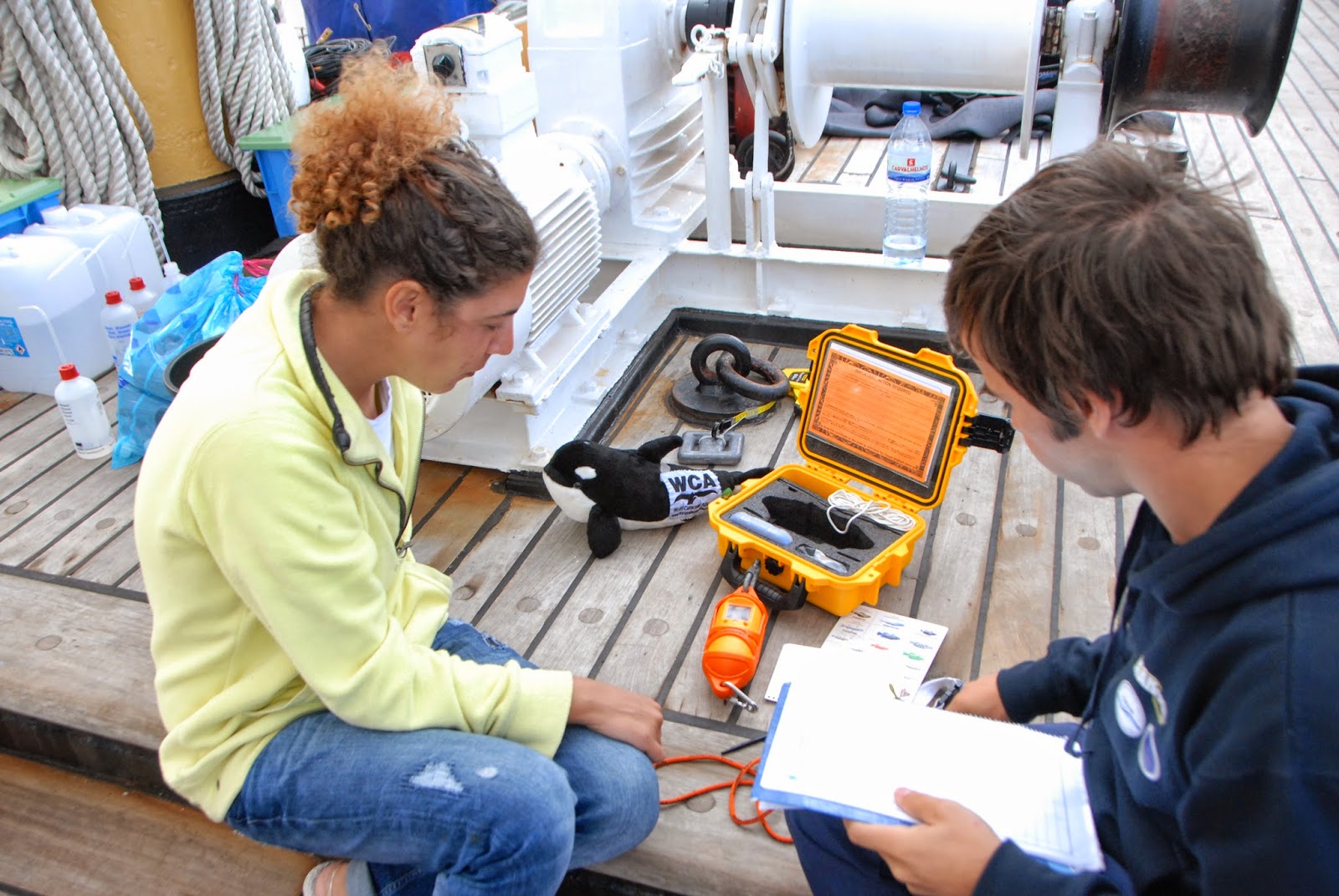
On board the Portuguese Navy vessel the Creoula

Andre Cid from the organisation and Morgan took part in scientific survey off the coast of Portugal to establish what biodiversity exists off the coast and where. While the survey looked a range of marine life, Morgan and Andre Cid were there to survey for cetaceans and turtles.   

Working with the scientists on board

On board the beautiful Creoula, originally a cod fishing boat used in the North Atlantic and now a training ship of the Portuguese Navy the team recorded all the whales, dolphins, porpoises and turtles they saw. This data will go towards identifying which species occur in the area, estimating the spatial distribution and relative abundance (i.e. where they occur and how many are there), assessing habitat use and population structures and towards comparing photo-identification pictures (photos of the dorsal fin that allow individual animals to be recognised) with existing catalogues.  

Looking out for whales and dolphins!

In addition to conducting visual surveys the team also monitored for whales and dolphins acoustically using a hydrophone, which is basically an underwater microphone that will pick up the clicks, whistles and any other vocalisations that the whales and dolphins may be making. By plugging the hydrophone into a computer these vocalisations can be recorded and also visualised on screen. 

Click to discover more about the work of AIMM!

The acoustic monitoring system