Monday, 12 January 2015

Dolphin Watching in Portugal

What does someone who surveys marine mammals do on their day off? Go whale watching of course! It is more than a job or a hobby or an interest. Whale and dolphin watching gets into your blood, it is your passion. For our little Morgan spending time at sea on the water, watching her cousins swimming wild and free is the best feeling in the world. So when Andre Cid decided to do some dolphin watching around the Algarve in Portugal between work for WCA partner AIMM, it was only natural that he took Morgan with him.

Out on that wonderful blue ocean

First off they headed out from Alfubeira where AIMM has its research centre, on a small Rigid Inflatable Boat (RIB) in search of dolphins. Zooming over the azure blue sea Morgan and Andre scanned the waters for those signs that dolphins are around. A splash, a dark fin or back…. This time it was not meant to be. No dolphins or whales. But that is the way it is with wild whales and dolphins. That’s the point. They are wild. That is not to say there is nothing else to see. Just being out on the Ocean is bliss to Morgan, and this time the trip took them to see some of the spectacular geology of the region. Gently floating on the water, the RIB took them into one amazing cave so large it is aptly called Cathedral! 


Just a few short weeks later and Morgan and Andre Cid were back out on the water. This time with WCA partner Cape Cruiser, based in Sagres. Once again they headed out across the blue waters in search of whales and dolphins. This time their luck was in! Pods of common and then bottlenose dolphins skimmed through the waves nearby. A group of small harbour porpoise, one of the smaller species of cetacean, rolled at the surface, their breath coming in short puffs. Then there was a minke whale, bigger than dolphins but actually one of the smallest baleen whales. Finally when things felt like they could not get any better…. Orca! A small group, eight or nine and for these waters a rare sight! In five years of working at sea in this region, this is only Andre Cid’s third sighting of Orca! What a rare and special treat!

Wishing you all a very Happy New Year from Follow Free Morgan!

Thursday, 11 December 2014

A Whale of a Time

Imagine standing next to a life sized Orca. For some of us we have been lucky enough to be on a boat, big or small, when one of these magnificent marine mammals surfaces nearby. The moment is inspirational, breath taking and one that many do not forget. Even then you only see a small part of the animal. Perhaps the head, back and enormous dorsal fin towering above the waves. Occasionally you might be really lucky to see one leap clear, throwing themselves out of the water and crashing back down with an almighty splash. But not everyone is so lucky, whether they cannot afford to go, or are not near any prime Orca habitat. So again imagine standing next to a life sized Orca. It is big, reaching almost 10 m in length and its tall, to the tip of its dorsal fin it towers over you, your mum, even your really tall dad! It’s bold, black and white with huge paddle like flippers. It is a view very few would ever see in a wild animal, and who wants to see the shadow of a wild Orca that is those subject to a life in captivity. 

A wild and free Orca

There were so many wonderful things at WhaleFest 2014, things that really inspired kids, parents, students and anyone else who ventured to the world’s biggest festival of whales and dolphins. And it wasn’t just Steve Backshall (although he was pretty inspirational!). For our little Morgan what really stuck in her mind was things like the life sized humpback whale, based on a real, known whale off America called Niall and the release of a life sized Orca into the sea off Brighton. Of course (and unfortunately) it was not a real Orca, but it looked pretty realistic. Such items have a massive impact. So imagine being able to have a life sized Orca to use year after year at WhaleFest and to take on the road to events around the country? Imagine being able to inspire hundreds, thousands of people by bringing them into close contact with a life sized whale, inspiring them to care and to protect these incredible creatures.

Morgan at WhaleFest 2014, with the life sized inflatable Orca

WhaleFest has fantastic support from those people who currently own such incredible replicas. But to be able to really make this work the team needs their own replica. Their own inflatable life sized Orca. And to do that they need help. Overall the funds needed may seem overwhelming, a large sum of money. But break it down into small chunks and ask your friends, your friends friend, your mum, your dad, your aunty, your work colleagues, everyone and anyone to make one small donation and very soon that large sum is reachable. And that is the idea behind crowd funding. 

And so WhaleFest has launched a crowdfunding appeal backed by Monty Halls, Gok Wan and supported by The Body Shop Foundation, to raise enough money to build a life sized replica Orca. But more than that it is supported by general people who have pledged their support for this inspirational idea. Our little Morgan has pledged her support, and would ask will you too?

There are only 21 days left and still 50% of the funds to go. Will you pledge, share and support the WhaleFest Team? Will you help bring to life an idea that will inspire generations to love and protect whales?


Friday, 5 December 2014

Surveying Cetaceans in Portugal

From enjoying Humpback Whales in Hawaii and Panama, Morgan was back across the Atlantic and participating in a survey for cetaceans and turtles with WCA partner AIMM – Marine Environment Research Association in Portugal. AIMM conducts research in partnership with universities, research centres and other Non-Governmental Organisations, to increase the knowledge of marine ecosystems in Portugal. 

On board the Portuguese Navy vessel the Creoula

Andre Cid from the organisation and Morgan took part in scientific survey off the coast of Portugal to establish what biodiversity exists off the coast and where. While the survey looked a range of marine life, Morgan and Andre Cid were there to survey for cetaceans and turtles.   

Working with the scientists on board

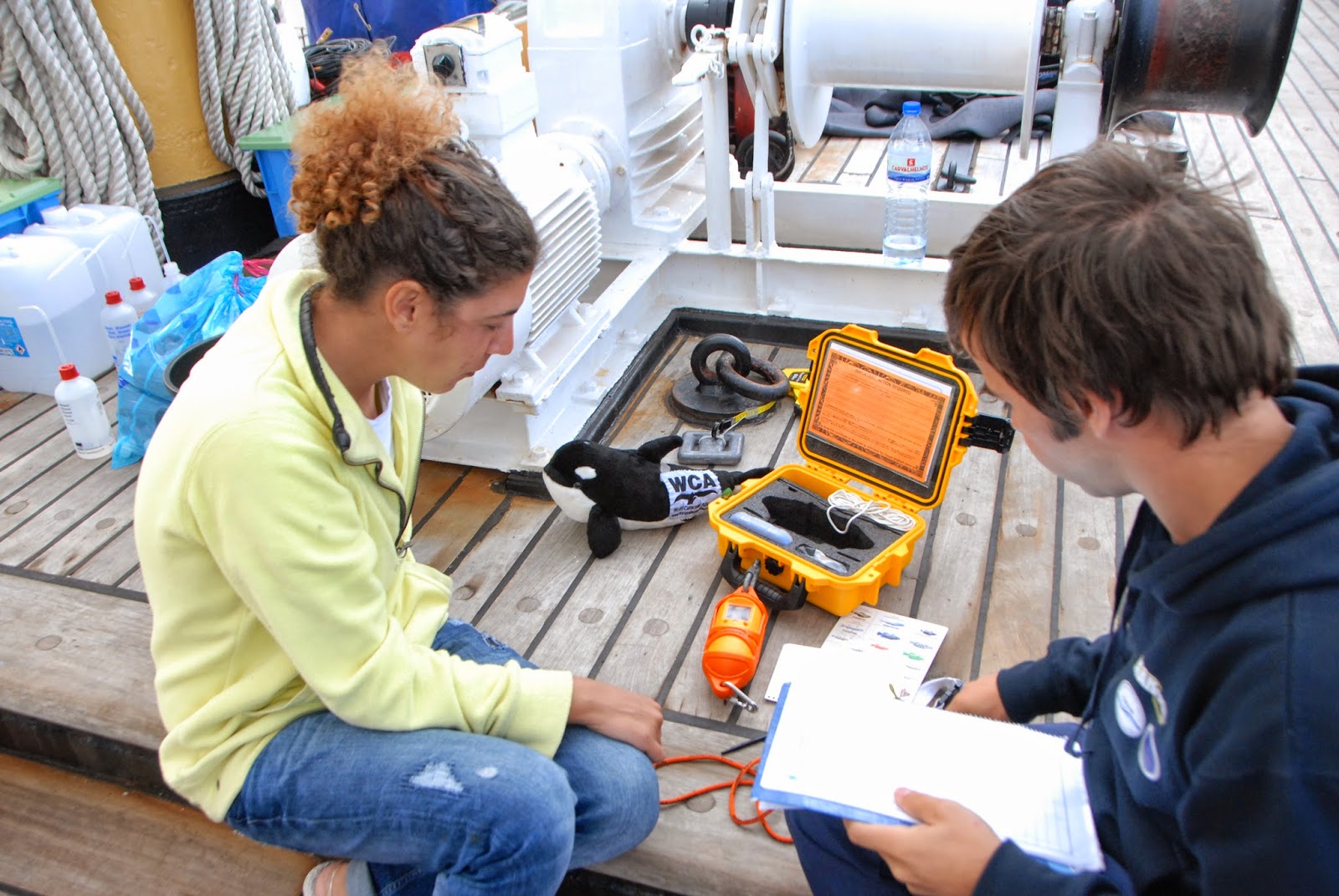
On board the beautiful Creoula, originally a cod fishing boat used in the North Atlantic and now a training ship of the Portuguese Navy the team recorded all the whales, dolphins, porpoises and turtles they saw. This data will go towards identifying which species occur in the area, estimating the spatial distribution and relative abundance (i.e. where they occur and how many are there), assessing habitat use and population structures and towards comparing photo-identification pictures (photos of the dorsal fin that allow individual animals to be recognised) with existing catalogues.  

Looking out for whales and dolphins!

In addition to conducting visual surveys the team also monitored for whales and dolphins acoustically using a hydrophone, which is basically an underwater microphone that will pick up the clicks, whistles and any other vocalisations that the whales and dolphins may be making. By plugging the hydrophone into a computer these vocalisations can be recorded and also visualised on screen. 

Click to discover more about the work of AIMM!

The acoustic monitoring system

Thursday, 27 November 2014

Matylda and Morgan

There once was a little girl called Matylda who went on a wonderful adventure to Panama with her mum, dad, little sister Edith, and a very special little Orca called Morgan. Nestled in central America with the Caribbean Sea on one side and the vast Pacific Ocean on the other, Panama is home to wild tropical jungle, golden sandy beaches and blue turquoise water filled with coral reefs, colourful fishes and a multitude of marine creatures including whales and dolphins. Morgan was honoured to join this family on their adventure, and while she cannot speak ‘human’ Matylda has spoken for Morgan by writing down her adventures with this little whale in this special place.

Morgan's Holiday Book By Matylda

Matylda, her family and Morgan headed to Contadora Island, set off the southern, Pacific coast of Panama and here they headed out in search of humpback whales and dolphins. In Matylda’s words "Morgan has had a brilliant time with us. Morgan came on a boat trip with us and another family. We saw Humpback Whales. Morgan went on a catamaran and we saw Spotted Dolphins but Edith was asleep. We were on a net (the cat had a net to sit on the bow). We had a brilliant time!"

Matylda's drawing of her family and Morgan onboard a catamaran whale watching!

Did you know that Panama is the only place in the whole world where Humpback Whales from both the Northern and Southern Hemisphere come to breed!? The dolphins that Morgan and Matylda saw were Pantropical Spotted Dolphins, the species most commonly encountered in the waters off Panama. They are curious and very interactive, often swimming for hours and playing around the boats.

Pantropical Spotted Dolphin (not from Panama but the same species!)

Morgan and Matylda went whale watching with World Cetacean Alliance Partner, Whale Watching Panama. Click here to find out more about their trips and the magical place of Panama! 

Finally it is just left to us to say 'Thank You' to Matylda for taking our Morgan on this adventure, for speaking for her and telling us all about your adventure together.

Monday, 17 November 2014

Hawaii

Leaving New London and Wyland’s Wall, our little Morgan headed to the 50th and most recent state to join the United States of America: Hawaii! Surrounded by the vastness of the Pacific Ocean, the state encompasses the volcanic Hawaiian Archipelago, hundreds of islands spread over 1500 miles. Morgan travelled to the third largest of the islands, Oahu, with WCA partner Patti Sullivan from CSI. 

Together they circled the island, exploring its volcanic landscape, the lush green slopes that meet golden beaches and turquoise blue waters. From Honolulu they headed to the southern shore where they gazed upon Diamond Head crater, an inactive volcano and the Hawaiian ‘money shot’. From there they headed to the fabled north shore where surfers ride huge glassy winter waves. 

Enjoying the stunning scenery of Oahu

And the best bit for Morgan? Finding the information boards about The Humpback Whale National Marine Sanctuary and even seeing the wispy blows of Humpback Whales just offshore! These whales have just returned to the warm tropical waters around the islands from Alaska where they have spent the northern summer gorging on the abundance of food found in those cool waters. In Hawaii they will mate, give birth, and not feed until they have returned north next spring. 

Learning about the sanctuary, and watching whales!

The sanctuary is managed by the National Oceanic and Atmospheric Administration (NOAA) and the State of Hawaii. Through research, education, outreach, regulations and guidelines the sanctuary aims to protect the Humpback Whales, their habitat and the cultural heritage of the islands. 

As they read Morgan and Patti leaned about the issues that whales face even within the comparative safety of the sanctuary, from water quality to marine debris to acoustic disturbance. For Morgan the one that caught her attention the most was entanglement. In many cases Humpback Whales will drag nets, lines, pots and gear all the way from Alaska! It is an incredible, arduous journey at the best of times, let alone dragging a load of fishing gear all that way. It was only in February this year that a whale was rescued from fishing gear in the waters around Hawaii. That was possible through the Hawaiian Islands Disentanglement Network, a community based network formed in 2002 to free Humpback Whales and other marine animals from entanglement. It is wonderful to know there are dedicated people willing to protect Humpback Whales and their habitat, and work to free them where possible when they become entangled. 

Read more about the work of the sanctuary and the Disentanglement Network at http://hawaiihumpbackwhale.noaa.gov/welcome.html. and find more photos of Morgan's adventure to Hawaii at Morgan's Facebook page 

For Morgan there was one last chance to enjoy the lemon yellow sunset that is so hard to find anywhere else, before heading off on her next adventure...


Sunday, 9 November 2014

From London to New London

From London, England and standing in front of New Zealand House petitioning for the smallest and one of the rarest dolphins in the world, Morgan was back in the USA. This time she was exploring the history of New London, Connecticut. During the height of the whaling era in the early 19th Century, New London was one of the busiest whaling ports. Oil from whales was exploited but essential to much of the industrial development of the area, with the wealth invested in railroads and hospitals. In the 21st century there is now a recognition for the need to save whales and preserve our ocean environment in a sustainable way. While there are still some countries that hunt whales, thankfully in many countries it is now simply a part of their history. 

Morgan and the history of whaling in New London

A prominent landmark in New London is Wyland’s Whale Wall. Wyland, an American artist best known for his Whaling Walls; large murals painted on buildings across America, featuring life-sized whales.  In New London there was only really one species that could be painted, the whale most hunted by Connecticut whalers in the 1800s, the Sperm Whale. It was Dr Robbins Barstow, one of the founders of WCA partner Cetacean Society International (CSI) and who dedicated his life to saving whales, leading the charge in the effort to stop the slaughter of whales, who invited Wyland to paint the wall in New London. In July 1993 and within one week Wyland had created his Sperm Whale masterpiece. 

Morgan at Wyland's Whale Wall in New London

Over the years the painting began to deteriorate and in 2006 there was even talk of painting over the wall. It was the residents of the city who united with CSI to protect and restore the wall, so that it remains as an icon of awareness and inspiration to these incredible underwater creatures. For Morgan is was a chance to wonder through the history of this place with current members of CSI Patricia Sullivan and Paul Di Gangi. 

Read more about Dr Barstow in CSI’s Whales Alive newsletter written by one of our Morgan’s best friends, Patricia Sullivan. Find out more about the work of CSI at their website

Check out Follow Free Morgan's Facebook page for more photos of her adventure around New London, and while you are there why not Like and Follow us!

Sunday, 2 November 2014

A Vigil for Maui's and Hector's Dolphins

30th October 2014 and Dr Barbara Maas and Dr Liz Slooten, Champions of the smallest and one of the most threatened sub-species of dolphin, the Maui’s Dolphin, came to New Zealand House in London to hand over a petition of over 156,000 signatures to the New Zealand High Commission. From an estimated 1800 40 years ago, today there are only 50 Maui’s Dolphins left and they are only found around the North Island of New Zealand. While there are more Hector’s Dolphins (the other sub-species which are only found around the South Island of New Zealand) they too are in need of urgent protection. Both are at severe risk of entanglement in set-net fishing gear. The Maui’s Dolphin in particular is on the edge of extinction. 

Morgan, and mini Maui's and the Petition

What do they need? Full and complete protection from harmful fishing methods across their range. The world’s leading independent scientists, including those from the International Whaling Commission, the International Union for the Conservation of Nature (IUCN), the Society for Marine Mammalogy, and World Cetacean Alliance partners including Dr Maas herself, all agree. So do 156,523 members of the public. People who do not want to see this small, charismatic, endemic and unique dolphin disappear; People who want future generations to be able to see these dolphins, wild and free. 

Our little Morgan feels the same. With WCA partners Rachael Barber and Isabelle Sikora, Morgan joined a small but dedicated group of Maui’s and Hector’s Dolphins advocates to watch as Dr Maas and Dr Slooten handed over the results of this petition. 

Then with the red buses, taxis and general London traffic rumbling behind us, we handed out leaflets and cheered every honk for Maui’s and Hector’s Dolphin. 

Find out more about Hector’s and Maui’s Dolphin and the campaign to protect them at www.hectorsdolphin.com or the Hector’s and Maui’s Dolphin SOS Facebook page www.facebook.com/groups/hectorsandmauissos. Why not follow them on Twitter @HectorsMauisSOS, and let’s make as much noise for these the Hobbits of the Sea.